Kansas Wildflowers: A Guide to Seasons & Locations
Updated: Apr 3
Follow the rhythm of the prairie with this guide to Kansas wildflower seasons, bloom times, and photography best practices.
Kansas native plants tell a deeper story—one of survival, adaptation, and beauty rooted in place. Learn when wildflowers bloom, where to find them, and how to document them through thoughtful nature photography.

There’s a moment each year when the prairie begins to speak in color.
It starts subtly. A low bloom tucked close to the ground. A flicker of purple or yellow against still-muted grass. Easy to miss if you’re moving too fast. But over the course of weeks, that quiet beginning builds into hills brushed with color, roadsides lined with blooms, and wide-open landscapes that feel, for a time, almost painted.
Kansas wildflowers don’t arrive all at once. They unfold in waves, shaped by rainfall, sunlight, and the deep-rooted resilience of native plants. To experience them well requires something more than timing. It requires attention to the land, to the season, and to the details that define this place.
This is your guide to finding Kansas wildflowers—when to go, where to look, and how to experience them with intention.
When Kansas Wildflowers Bloom (A Seasonal Guide)
To follow wildflowers in Kansas is to follow a season in motion. Each phase offers something different—subtlety, abundance, or bold expression.
The first blooms are often the most fleeting.
Early Spring (March–April)
Emerging before the prairie fully wakes, early spring wildflowers appear close to the ground, shaped by cold nights and unpredictable weather. Species like Missouri Evening-Primrose and spring beauty signal the beginning of the season—delicate, short-lived, and easy to overlook.
For those willing to seek them out, this is a quieter kind of reward. Less spectacle. More discovery.
Late Spring to Early Summer (May–June)
By late spring, the prairie begins to fill in. Grasses turn green, and wildflowers follow—layering color across fields and hills. Butterfly milkweed, blue wild indigo, and early coneflowers begin to define the landscape. This is often the most diverse stretch of the season, when Kansas native plants create a tapestry rather than a single note.
It’s also one of the most forgiving times to explore. The prairie feels full, alive, and expansive.
Summer to Early Fall (July–September)
Then comes the season most people recognize.
Black-eyed Susans, blazing star, goldenrod, and sunflowers take hold—bold, upright, unmistakably Kansas. The color palette shifts warmer. Yellows deepen. Reds intensify. As the weather cools, native plants, grasses, and late-season wildflowers across the landscapes shift to warmer hues.
This is the Kansas prairie landscape at its most iconic—where wildflowers don’t just complement the landscape, they define it.

Where to See Kansas Wildflowers
Wildflowers can be found across the state, but some places offer a deeper sense of scale—and connection.
The Flint Hills
If Kansas has a wildflower capital, it is here.
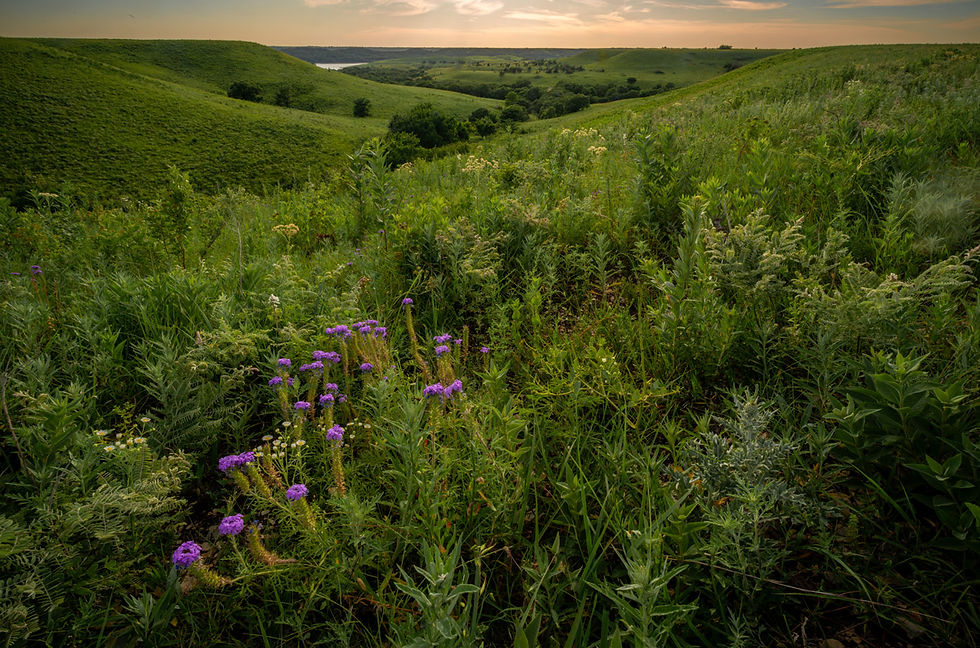
The remaining tallgrass prairie of the Flint Hills offers one of the most intact ecosystems in North America. Rolling hills stretch uninterrupted, creating natural layers that shift with light and season.
Places like Tallgrass Prairie National Preserve provide both access and context—trails that move through native grasses, interpretive spaces that explain what you’re seeing, and a sense of how rare this landscape truly is.
Further north, the Konza Prairie Biological Station offers another window into the tallgrass ecosystem, where research and preservation intersect.

State Parks & Wildlife Areas
For accessibility, Kansas state parks and refuges offer reliable opportunities to experience wildflowers up close.
At Maxwell Wildlife Refuge, prairie landscapes unfold alongside roaming bison and elk. Near Lawrence, Clinton State Park offers trails where native plants thrive along the edges of water and in the woodland. Kansas' western state parks, such as Little Jerusalem Badlands and Historic Lake Scott, also showcase the state's wide range of native plants. In the high plains, you'll see more arid vegetation–prickly pear cactus
These spaces balance preservation with access—making them ideal for both casual visitors and photographers.
Roadsides & Backroads
Some of the most striking displays aren’t found on a map.
Kansas roadside–particularly rural routes–often host dense clusters of native wildflowers. Maintained less frequently and shaped by natural cycles, these spaces can rival more formal destinations.
They also require care. Pull over safely. Be mindful of traffic. And remember that what you’re seeing is part of a larger ecosystem, not a roadside attraction. It's also more than likely private property. Be thoughtful and respectful of all signs, and don't cross fence lines.
Local Public Prairies & Preserves
Across Kansas, small pockets of preserved prairie remain—often managed by local organizations or conservation groups. Some public prairie spaces, such as Mount Mitchell Heritage Prairie Park and Baker Wetlands, are near urban areas and offer an immersive experience without requiring a long drive.
A chance to take in Kansas native plants not as scenery, but as presence.
Kansas Native Plants: Why They Matter
Wildflowers are only one part of a larger story.
Kansas native plants are shaped by this land—its cycles of drought and rain, fire and regrowth. Their roots run deep, sometimes extending several feet into the soil. This allows them to endure extremes, stabilize the land, and support a network of life above and below ground.
Pollinators depend on them. Soil health depends on them. The prairie itself depends on them.
To understand Kansas wildflowers is to understand that they are not ornamental. They are essential.
Best Practices for Viewing Wildflowers
Experiencing wildflowers comes with a responsibility to protect them.
Stay on established paths when possible. Avoid stepping into dense patches of blooms. Do not pick flowers—what seems small in the moment can have a lasting impact on pollinators and plant regeneration. To view and learn about Kansas native plants and wildflowers, the Friends of Konza Prairie hosts a wildflower walk each June.
As with all things wild, each year is different. The abundance of wildflowers depends on how much moisture the land receives during winter. Particularly dry winters and early springs make wildflowers scarcer.
Respect private land. Leave gates as you find them. Carry out what you bring in.
The prairie offers its beauty freely. The least we can do is meet it with care.
Kansas Nature Photography Tips for Wildflowers
Photographing wildflowers in Kansas is as much about the landscape as it is the subject. Work With the Light
Early morning and late evening offer the most forgiving—and most compelling—light. Shadows stretch. Colors soften. The prairie gains depth. Midday can be harsh, but even then, there are moments worth capturing. Use the Landscape
Wildflowers are rarely isolated here.
Instead of focusing solely on close-ups, step back. Use the rolling hills, the horizon, and the sky. Let the prairie tell the full story. Get Low
One of the simplest ways to change a photograph is to change your perspective. Shooting at the level of the flower—rather than above it—creates a sense of immersion. It places the viewer within the landscape, not outside it. Embrace the Wind
Kansas is rarely still. Rather than fighting the movement, work with it. Slight motion can add atmosphere. A pause in the wind can create a fleeting moment of clarity. Patience matters here. Keep It Simple
You don’t need complex gear to photograph wildflowers well. A wide lens can capture the landscape. A macro lens can reveal detail. What matters most is how you see—and how you choose to frame what’s in front of you.
Planning Your Kansas Wildflower Outing
Timing a wildflower outing is never an exact science. Rainfall plays a role. Temperature shifts matter. A bloom that peaks one week may fade the next. Check recent conditions. Stay flexible. And allow room for discovery. Some of the best wildflower experiences in Kansas aren’t planned—they’re found.





"Kansas Wildflowers: A Guide to Seasons & Locations" was a great read, and I liked how clear and grounded the writing felt. I also liked how you touched on fake address generator. This fits well with Generate random addresses for testing and demo scenarios.. Appreciate you publishing this.